

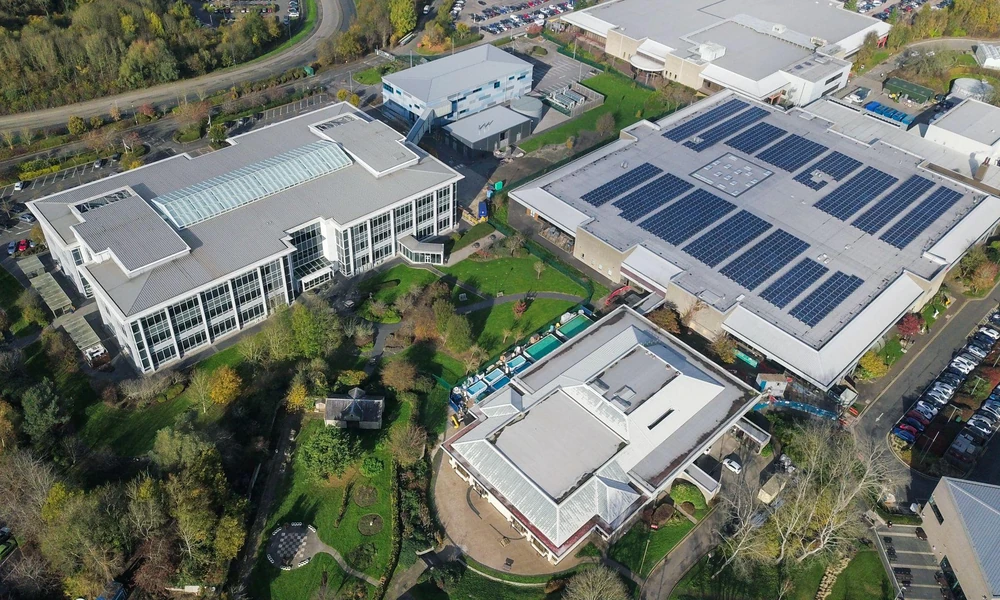
Image Recommendation: Solar panels in the foreground with a data centre building visible in the distance under a clear sky.
Almost every data centre operator now describes itself as sustainable, which means the word on its own has stopped telling a prospective tenant very much. Sustainability claims have become close to universal in the industry’s marketing, but the actual design decisions behind them, how power is sourced, how heat is managed, how a site’s footprint is measured, vary enormously from one operator to the next. The claim is common; the substance behind it isn’t.
Three Numbers Worth Asking About Before Taking the Claim at Face Value
- Power usage effectiveness: how much energy actually reaches the servers versus cooling and overhead
- The share of power drawn from renewable sources directly, rather than purchased as offset credits
- Water consumption per megawatt, particularly relevant for cooling-intensive climates
What ‘Top’ Tends to Mean Changes Depending on Who’s Asking
Searches for top data centre companies tend to return rankings built around scale, uptime, or geographic footprint, since those are the easiest things to measure and compare across operators. Sustainability performance is harder to rank consistently because operators report it differently; some disclose detailed power usage effectiveness figures, while others describe sustainability in broad terms without the underlying numbers. A shortlist built purely on scale or reputation can miss this distinction entirely, since a large, well-known operator isn’t automatically the one with the strongest environmental design.
That gap between reputation and disclosure is worth sitting with for a moment. A company can be large and well known in the industry without ever publishing the figures that would let a prospective tenant compare its environmental performance against a competitor’s, and a smaller, less visible operator can be more transparent by comparison. Scale and sustainability are simply answering different questions, and treating one as a proxy for the other is where a lot of shortlists go wrong before any real comparison has even started.
Does Renewable Energy Actually Mean the Same Thing Everywhere?
Not quite. Data centre sustainability can mean a facility purchases renewable energy certificates to offset its grid consumption on paper, or it can mean a facility is physically connected to solar, wind, or hydro generation that feeds its own supply directly. Both get described as renewable in marketing material, but only one changes how the power actually reaches the building. K2 Strategic’s approach leans toward the second: treating renewable sourcing as part of the site’s power design from the outset, rather than a certificate purchased afterwards to offset a grid mix that hasn’t changed.
A Sustainable Design Starts Before the First Server Rack Arrives
By the time a facility is operational, most of its environmental performance has already been locked in by decisions made at the design stage: where the power comes from, how cooling is engineered for the local climate, and how much excess capacity is built in versus scaled to actual demand. Retrofitting sustainability into an existing site is possible but limited, which is part of why the design phase carries more weight here than it does for many other infrastructure questions a tenant might evaluate.
The Harder Question Is Whether the Numbers Hold Up Under Scrutiny
Asking an operator to share its power usage effectiveness figures, its renewable sourcing arrangements, and how those numbers are independently verified tends to separate genuine design commitments from marketing language fairly quickly. A company confident in its own figures will usually share them without much friction; one relying mainly on broad claims may be slower to produce the underlying detail, or may redirect the conversation toward scale and uptime instead, which are real credentials but not substitutes for the environmental ones being asked about.
Third-party verification matters here too. A figure an operator reports about itself carries less weight than one checked against an independent standard, and the gap between the two becomes obvious fairly quickly once a tenant starts comparing shortlisted operators side by side on the same set of questions rather than taking each one’s own summary at face value.
None of this means every company using the word loosely is being misleading, since sustainability reporting standards across the data centre industry are still catching up to how fast the sector has grown. It does mean the word itself is no longer a reliable shortcut, and the operators worth taking seriously are usually the ones willing to be specific rather than general.
K2 Strategic treats renewable sourcing as part of how a site is designed, not a line added to a brochure afterwards. Contact K2 Strategic to see the figures behind that approach.